

What are the main uses of zinc oxide produced by the indirect method?
2022-11-25
What are the main uses of indirect zinc oxide? Indirect process zinc oxide, also known as French process zinc oxide, was promoted by French scientist Leclaire in 1844. The indirect process typically uses zinc ingots as raw materials. Zinc ingots are converted into zinc vapor in a graphite crucible at a high temperature of 1000°C, then oxidized by blown air to produce zinc oxide, and the zinc oxide is collected after the cooling pipe to obtain zinc oxide particles.
What are the main uses of indirect zinc oxide?
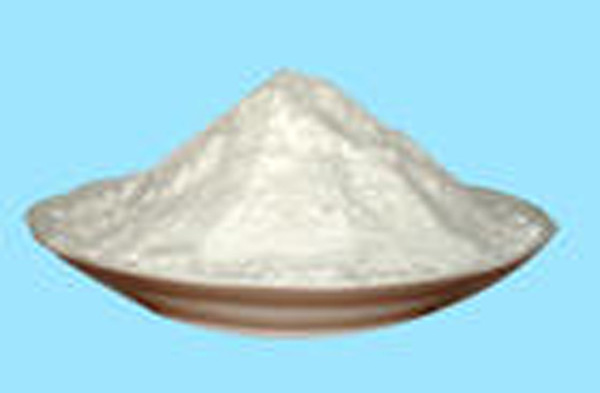
Indirect process zinc oxide (English name: Indirect process zing oxide ), promoted by French scientist Leclaire in 1844 year, also known as French zinc oxide. The indirect method usually uses zinc ingots as raw materials. Zinc ingots are converted into zinc vapor in a graphite crucible at 1000 ° C high temperature, and then oxidized by the blown air to produce zinc oxide. The zinc oxide is collected after the cooling pipe to obtain zinc oxide particles.
Indirect zinc oxide Mainly used in rubber manufacturing, silicate industry, medical and health, coloring materials, electronics and other fields, a specific analysis is as follows:
1. Rubber manufacturing
Industrially produced indirect zinc oxide 50% flows to the rubber industry. The product and stearic acid, as important reactants in rubber vulcanization, are one of the raw materials for rubber manufacturing. The mixture of the product and stearic acid improves the hardness of the rubber.
2. Silicate industry
It is an additive for cement, which can shorten the hardening time of cement and improve the waterproof performance of cement. In the production of glass and ceramics, this product can be used as a flux to reduce the sintering temperature of glass and ceramics. The transparency of indirect zinc oxide added with aluminum, gallium and nitrogen is as high as 90% , which can be used as a glass coating to reflect infrared rays while allowing visible light to pass through. This coating can be applied to the inside or outside of window glass to achieve heat insulation.
3. Medicine and health
This product has a deodorant function, so it is often added to cotton fabrics, rubber, food packaging, etc. The product added to food not only has a certain antiseptic effect, but also can be used as a zinc source to supplement the zinc element needed by the human body.
4. Coloring materials
It is known as zinc white in pigments, and its transparency is between lithopone and titanium dioxide. Chinese white is a special zinc white, which is a pigment used by painters for painting. Compared with traditional white lead, zinc white can last a long time in sunlight, is not polluted by sulfur air, and is harmless and inexpensive.
5. Electronics field
This product has a high energy band gap at room temperature, so it is often used to manufacture laser diodes and light emitting diodes. Compared with gallium nitride with the same high energy band gap, it has a larger exciton binding energy (about 60meV at room temperature), so its luminescence brightness is higher. It has been used in solar cells and liquid crystal displays.
Manufacturing Indirect zinc oxide The method is as follows: the zinc ingots obtained by electrolysis are placed in a high-temperature crucible, heated to 600~700 ℃, melted, evaporated at a temperature higher than 907 ℃ (usually about 1000 ℃), forming zinc vapor, which is oxidized by oxygen in the air to produce zinc oxide. This oxidation process will emit bright light, accompanied by a decrease in temperature. Then, the zinc oxide particles are collected in the dust collection chamber through the cooling transfer pipe, used for cyclone separation, and the fine particles are collected by the dust bag to obtain the finished zinc oxide.
This synthesis method was promoted by Frenchman Leclaire in 1844 year, so it is also known as French law. The product obtained by this method is usually zinc oxide particles with an average size of 0.1 to 10 micrometers. By weight, most of the world's zinc oxide is produced by this method.
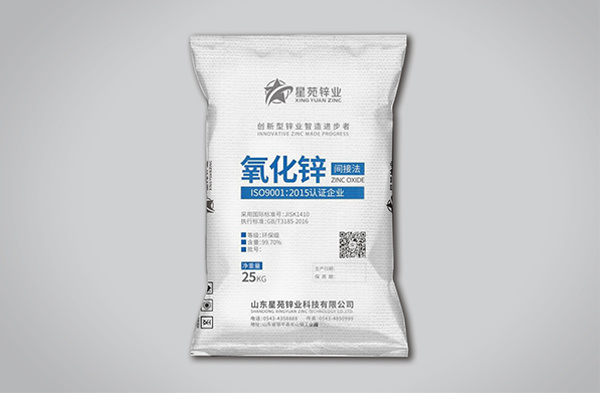
Xingyuan Zinc Technology CO., LTD.
Address: Shandong Zouping County Changshan Town Houhuai Village
General Manager:+8618763028888 (Sun Dongsheng)
Sales Department:+86-543-4358888
Fax:0543-4850999
E-mail:xingyuanchem@163.com
Website:www.sdxyxy.com


扫一扫查看官方网站